 Stool Log
Chronic diarrhoea: when loose stools last 4 weeks or more
Chronic diarrhoea is diarrhoea that lasts at least 4 weeks, either all the time or coming and going.1 A stomach bug clears up in days; diarrhoea that carries on for weeks is likely to be a sign of an ongoing problem, so it's one for a doctor to look into.2
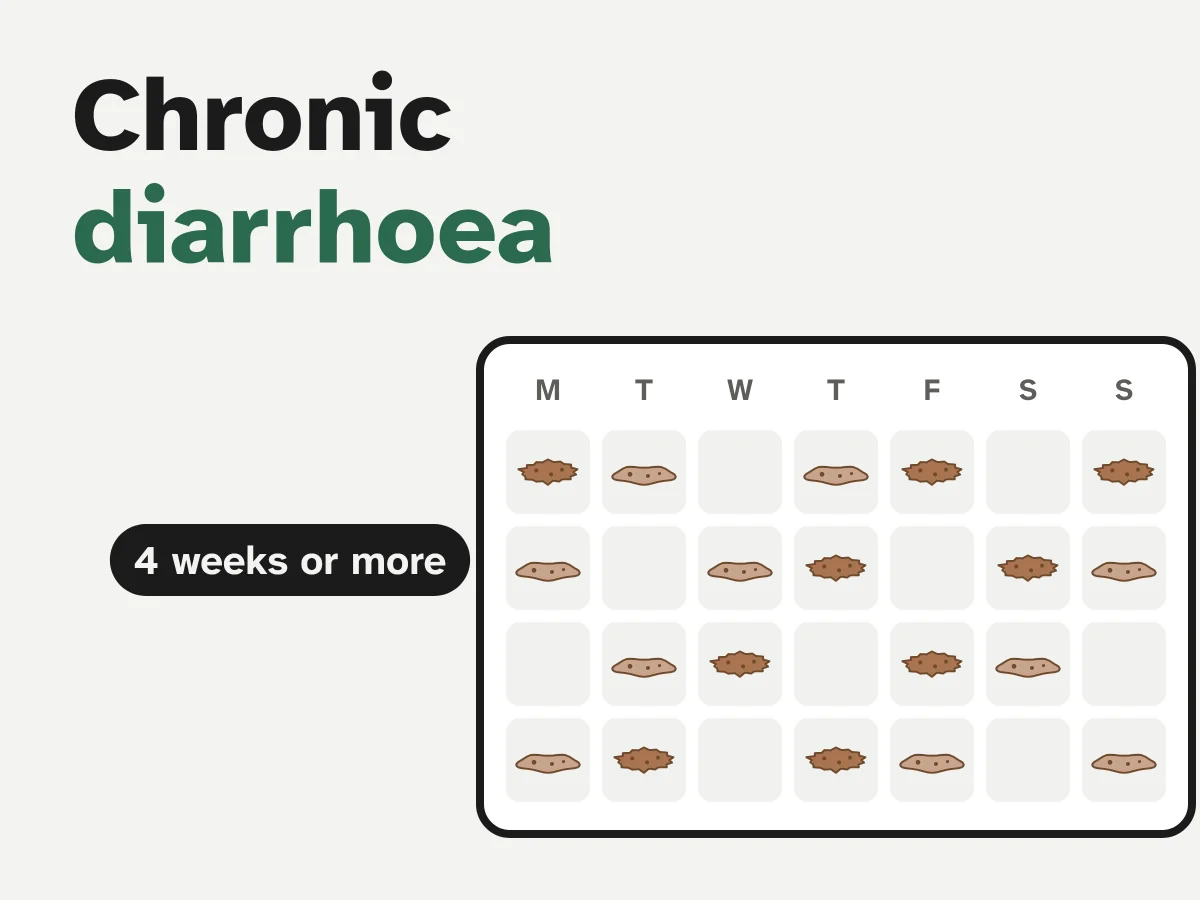
How is chronic diarrhoea different from a stomach bug?
Chronic diarrhoea lasts at least 4 weeks, while acute diarrhoea typically lasts less than a week and goes away on its own.1 Doctors sort diarrhoea by how long it lasts:1
| Type | How long it lasts |
|---|---|
| Acute | Typically less than a week, and goes away on its own |
| Persistent | 2 to 4 weeks |
| Chronic | At least 4 weeks |
Chronic diarrhoea isn't rare: research suggests up to 5% of people in the United States have it.1
The difference isn't only time. A bug usually comes from an infection that clears. Chronic diarrhoea comes from something that keeps going: some infections, food allergies and intolerances, digestive conditions, abdominal surgery or long-term use of medicines.3 It can also bring weight loss.3 If your body isn't absorbing food well, you may notice bloating, gas, a change in appetite, and loose, greasy, foul-smelling stools (more on floating, greasy poop).3
If you're still in the first week or two, how long diarrhoea lasts covers the usual course of a bug.
What are the common causes of chronic diarrhoea?
Common causes of chronic diarrhoea include irritable bowel syndrome,3 coeliac disease,4 inflammatory bowel disease,5 bile acid diarrhoea,6 some medicines taken for a long time3 and lactose intolerance.3
Irritable bowel syndrome (IBS)
The main symptoms of IBS are stomach pain or cramps, usually worse after eating and better after a poo, bloating, diarrhoea with watery poo and sometimes needing to go suddenly, and constipation.7 Symptoms can be better some days and worse on others, and may be triggered by food or drink.7 The NIH counts IBS and functional diarrhoea, chronic diarrhoea that isn't due to another cause, as disorders of gut-brain interaction.3 Our IBS food and symptom diary shows what to note.
Coeliac disease
In coeliac disease, the immune system attacks the body's own tissues when you eat gluten, which damages the small intestine so it can't take in nutrients properly.4 The diarrhoea may smell particularly unpleasant.4 It affects at least 1 in 100 people in the UK, and milder cases can be missed or mistaken for IBS.44
Inflammatory bowel disease (IBD)
The NHS lists the main symptoms of IBD as diarrhoea that lasts longer than 4 weeks, tummy pain, blood or mucus in your poo, bleeding from your bottom, feeling tired all the time and losing weight without trying.5 IBD is different from IBS, even though some symptoms can be similar.5
Bile acid diarrhoea
In bile acid diarrhoea, a form of chronic diarrhoea, the body doesn't recycle bile acids properly.6 It can also follow disease or surgery that damages the small bowel.6 Our post on bile acid diarrhoea covers it in more detail.
Medicines
Some medicines taken for a long time can cause chronic diarrhoea; antibiotics, for example, can change the gut's bacteria and raise the chance of a *C. difficile* infection.3 healthdirect also lists too many laxatives and some cancer treatments.2 If you think a medicine is behind it, talk to your doctor or pharmacist rather than changing it yourself. GLP-1 injections have their own post.
Lactose and other sugars
With lactose intolerance, you may get diarrhoea after foods or drinks containing lactose, the sugar in milk.3 Sucrose (table sugar) intolerance can do the same, and sugar alcohols in sugar-free sweets and gum cause diarrhoea in some people.33
Other causes
The NIH also lists diabetes-related nerve problems, problems with the pancreas, small intestinal bacterial overgrowth, and surgery on the appendix, gallbladder, bowel, liver or pancreas.33 If you were constipated before the runny poo started, read about overflow diarrhoea.
What will a doctor ask about chronic diarrhoea?
The NIH says a doctor may ask how long you've had diarrhoea, what your stool looks like and how often you go, what you eat and drink, your prescription and over-the-counter medicines, current and past medical conditions, and recent travel abroad.8 Most of the first appointment is questions.
They may also ask whether anyone in your family has digestive problems, food allergies or intolerances, or a condition that causes chronic diarrhoea.8 The exam may include checking for fever or dehydration, listening to and pressing on your tummy, a rectal exam, and comparing your weight with past weights.8
Our checklist of what to bring to a GI appointment helps you answer these without guessing.
What tests are used for chronic diarrhoea?
Tests for chronic diarrhoea include stool tests,8 blood tests,8 a hydrogen breath test,8 a change in diet8 and endoscopy,8 though not everyone needs every test. The NIH lists:
- Stool tests, to check for blood, bacteria, parasites or signs of disease.8
- Blood tests, which can show signs of some causes of diarrhoea, or dehydration.8 In the UK, coeliac testing is usually offered to people with symptoms or a family history.4
- A hydrogen breath test, for lactose, fructose or sucrose intolerance and small intestinal bacterial overgrowth.8
- A change in diet, avoiding certain ingredients to see whether the diarrhoea responds.8
- Endoscopy, such as a colonoscopy, to look inside the digestive tract.8
With ongoing diarrhoea, your doctor may refer you to a specialist for tests and to find the cause.2
What should you note before seeing a doctor about chronic diarrhoea?
Before the appointment, note each stool and its type, any blood, mucus or greasy stools, diarrhoea at night, your food and drink, every medicine and supplement, and your weight if it's changing.
- each stool, with its Bristol type, the time and how urgent it was
- blood, mucus, or greasy, floating stools
- diarrhoea that wakes you at night
- food and drink, especially dairy, gluten and sugar-free products
- every medicine and supplement, with the date you started it
- your weight, if it's changing
Common questions
How long before diarrhoea counts as chronic?
At least 4 weeks. Between 2 and 4 weeks is called persistent.1
Can chronic diarrhoea come and go?
Yes. Chronic diarrhoea symptoms may be there all the time or come and go.1 IBS symptoms also have better and worse days.7
Is chronic diarrhoea IBS?
Not always. IBS is one cause, but coeliac disease, IBD, bile acid diarrhoea, medicines and food intolerances are others, and coeliac disease can be mistaken for IBS.34 That's why a doctor looks for the cause.
Should I see a GP about diarrhoea that won't go away?
Yes. The NHS says to see a GP if you have diarrhoea that lasts more than 7 days.5
Weeks of stools, food and medicines on one page
Stool Log logs each stool's Bristol type in one tap, with chips such as Urgent, Mucus or Blood, and puts your food, symptoms and medicines on the same timeline. Insights shows your loose share day by day, Possible links appear after about 14 logged days, and the free 14-day doctor report is ready to print for the appointment.

Sources
- NIDDK (National Institutes of Health). Definition & facts for diarrhea, 2024. ↩ a b c d e f
- healthdirect (Australian Government). Diarrhoea, 2024. ↩ a b c d
- NIDDK (National Institutes of Health). Symptoms & causes of diarrhea, 2024. ↩ a b c d e f g h i j k l m n
- NHS. Coeliac disease, 2023. ↩ a b c d e f g
- NHS. Inflammatory bowel disease (IBD), 2026. ↩ a b c d e f
- NICE. SeHCAT for diagnosing bile acid diarrhoea (HealthTech guidance 598), 2021. ↩ a b c
- NHS. Symptoms of IBS (irritable bowel syndrome), 2025. ↩ a b c d
- NIDDK (National Institutes of Health). Diagnosis of diarrhea, 2024. ↩ a b c d e f g h i j k l m
This article is general information, not medical advice. Talk to a doctor or nurse about your own symptoms.
Read next
 Lactose intolerance symptoms: timing after dairy and what to noteLactose intolerance symptoms can start minutes to hours after dairy. What they are, how doctors test for it, and why a diary beats cutting dairy alone.
 How long does diarrhoea last? Adults, children and babiesHow long diarrhoea usually lasts in adults, children and babies, how a stomach bug tends to run, what changes the answer, and when it's no longer short-term.
 Floating poop: what it means and when to see a doctorPoop that floats after a fatty meal is rarely a worry. Greasy, pale, smelly floating poo that's hard to flush can mean fat isn't absorbed. When to get help.
 Coeliac disease or IBS? How to tell, and the test to ask forCoeliac disease and IBS share diarrhoea, pain and bloating. Why adults with IBS symptoms should be tested for coeliac, and why to keep eating gluten first.
 What to bring to a gastroenterologist appointmentA checklist for a GI or bowel appointment: your stool diary, medicines, history and the questions to ask, so you leave with answers.
 An IBS food and symptom diary that's easy to keepHow to keep an IBS diary of stools, food and symptoms without logging every bite, and how to read it after two weeks with your doctor or dietitian.